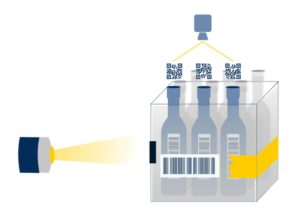
The piece-by-piece accounting of alcoholic beverages in the EGAIS 3.0 system is mandatory from July 1, 2018 in accordance with Federal Law No. 433-FZ.
Technological process in relation to alcoholic beverages production:
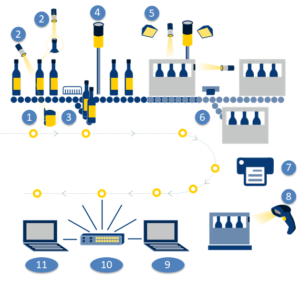
- Brand applicator
- Camera
- Bottle rejector
- Signal traffic light
- Lightning equipment
- Box Recipient
- Marking printer
- Scanner
- PC accounting system, camera control and data
- Network switch
- Factory server receiving data from the accounting system
The product accounting system is designed for piece-by-piece quantitative accounting of manufactured products, accounting for products as part of boxes and pallets. The following objects and procedures are subject to registration:
- single bottles of products;
- packaging in boxes;
- boxes in pallets.
Accounting automation object
The object – an automatic system of piece accounting (ACS PC) has three control points for finished products: a single product zone, a box formation zone and a pallet formation zone. The product passes each of the zones, the finished product is automatically recorded.
Single product area
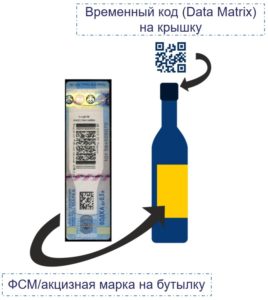
- Primary communication of FSS (federal special stamp), with the range of products, the possibility of further compliance control;
- FSS application control on the product;
- Controlling the application of the DataMatrix code to the bottle cap;
- Linking the codes from the bottle cap with the FSS;
- Rejecting products with unreadable codes;
- Controlling product compliance with FSS.
Box forming area
- Generating the code and accompanying human-readable data on the box label of the group packaging;
- Controlling label application with a code on the group packaging box;
- Linking the bulk packaging code with the DataMatrix codes from the bottle caps that are placed inside. Connecting group packing code with the FSS in this box;
- Rejecting boxes with unreadable group packing codes, or unreadable DataMatrix codes on bottle caps inside;
- Rejecting boxes if the number of bottles does not match the specified one.
Pallet forming area
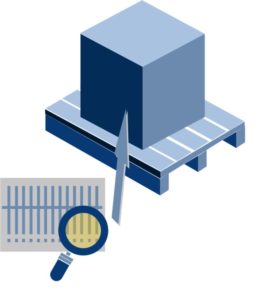
- Generating the code and related human-readable data on the pallet label;
- Controlling the label application with the code on the pallet;
- Associating the pallet code with the box codes included in this pallet. Associating the pallet code with the FSS numbers in this pallet;
- Controlling compliance of the number of boxes in a pallet with a given value.
The system’s main functions
- Determining the rejection cause, informing the line operator of the necessity to perform regulated actions;
- Maintaining a database and receiving statistical reports (all actions and events);
- Forming and storing archive recipes for a technological line and selecting the current one;
- Generating .xml report files with any given structure and transferring over the network;
- The ability to import/export data from the company’s data systems according to a separately agreed-to algorithm;
- User-friendly human-machine interface with different access levels.